
New release: Phenotypic impacts of embryonic exposure to the CSF1R inhibitor PLX5622 on craniofacial development
Published 09 April 2026
A new dataset is now available on FaceBase from Ma, Rosin, and colleagues at The University of British Columbia. Their study examines how disrupting CSF1R signaling, which is critical for macrophage and osteoclast development, affects craniofacial morphogenesis during embryonic development. A related manuscript is released on Development.
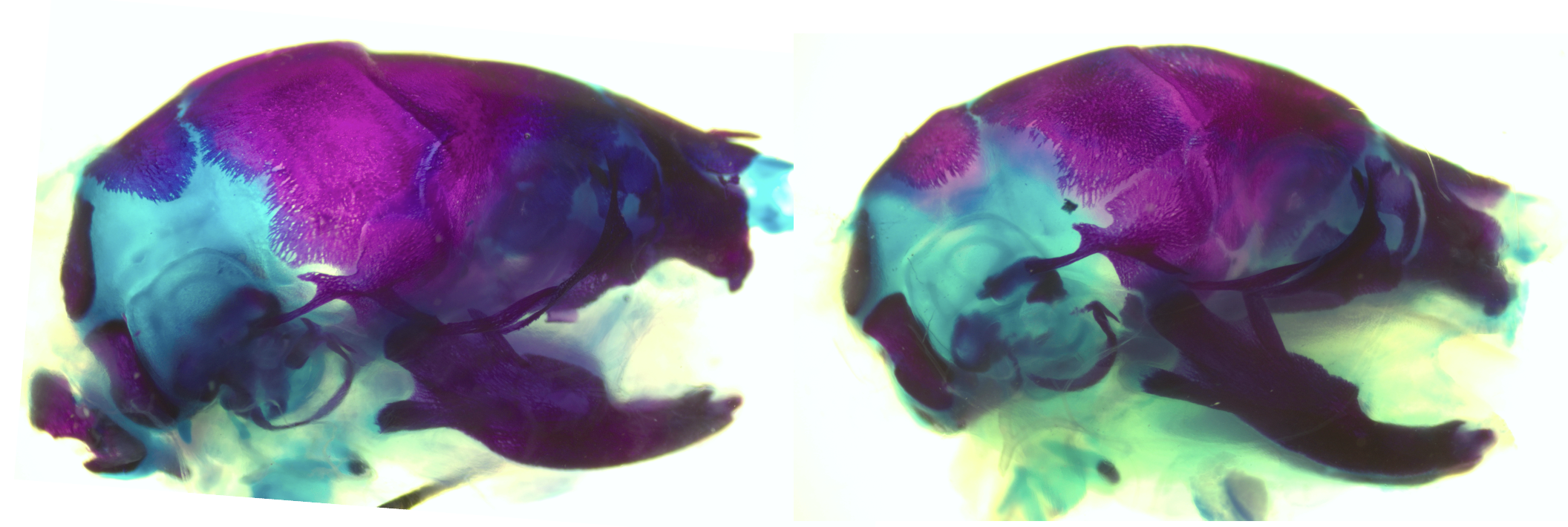 Control (left) and PLX5622-exposed (right) mouse crania stained for bone (red) and cartilage (blue), revealing craniofacial structural disruptions following prenatal CSF1R inhibition. Image courtesy of Felix Ma and Jessica M. Rosin.
PI: Jessica M. Rosin (the University of British Columbia)
Description:
Despite a wealth of knowledge on the mechanisms underlying craniofacial morphogenesis during gestation, the roles of fetal macrophages and osteoclasts during this process remain less well characterized. Here, we used the pharmacological inhibitor PLX5622 to disrupt colony stimulating factor-1 receptor (CSF1R) signaling, which is essential for macrophage and osteoclast proliferation, differentiation, and survival. Prenatal PLX5622 exposure resulted in ∼50% depletion of CSF1R+ macrophages, with complete loss of osteoclasts. While there were no notable changes in craniofacial nerve or muscle development, prenatal exposure to PLX5622 resulted in skull doming and cranial suture impairments, in addition to disruptions to development of the premaxilla, mandible, ear ossicles, palate, and cranial base. In response to PLX5622 exposure, cytokine and chemokine signaling was altered and neural crest proliferation was impaired. Our data also highlight sex- and strain-specific differences in PLX5622 phenotypes and together demonstrate that CSF1R+ macrophages and osteoclasts are essential for craniofacial morphogenesis.
Data deposited on FaceBase include images of control and PLX5622-exposed whole-mount E11.5, E12.5, and E13.5 nerve (2H3) and muscle (MF 20) antibody staining and P1 skeletal staining.
FaceBase Dataset:
Felix Ma, Jessica M. Rosin. Phenotypic impacts of embryonic exposure to the CSF1R inhibitor PLX5622 on craniofacial development. FaceBase Consortium https://doi.org/10.25550/A9-12PJ (2026).
Publication:
Felix Ma, Rose Ru Jing Zhou, Matthew Rosin, Iris Zhou, Sabrina Ownsworth, Rouzbeh Ostadsharif Memar, Vincent B. Wong, Jessica M. Rosin; CSF1R+ macrophage and osteoclast depletion impairs neural crest proliferation and craniofacial morphogenesis. Development 2026; dev.205423. doi: https://doi.org/10.1242/dev.205423