
Published 25 August 2026
A new dataset from the Chai lab at the University of Southern California is now available in FaceBase, combining single-cell RNA sequencing, bulk RNA sequencing, and SeqFISH spatial transcriptomics to examine how sensory nerves shape the developing soft palate.
Contributors: Sa Cha, Jifan Feng, Tingwei Guo, Lin Meng, Peng Chen, Calista Ly, Thach-Vu Ho (Center for Craniofacial Molecular Biology, Herman Ostrow School of Dentistry, University of Southern California); Pedro A. Sanchez-Lara (Section of Medical Genetics, Department of Pediatrics, Guerin Children’s at Cedars-Sinai Medical Center); Lauren E. McElvain and Jeffrey D. Moore (Department of Biological Sciences, Dornsife College of Letters, Arts and Sciences, University of Southern California); Yang Chai (Center for Craniofacial Molecular Biology, Herman Ostrow School of Dentistry, University of Southern California)
Description:
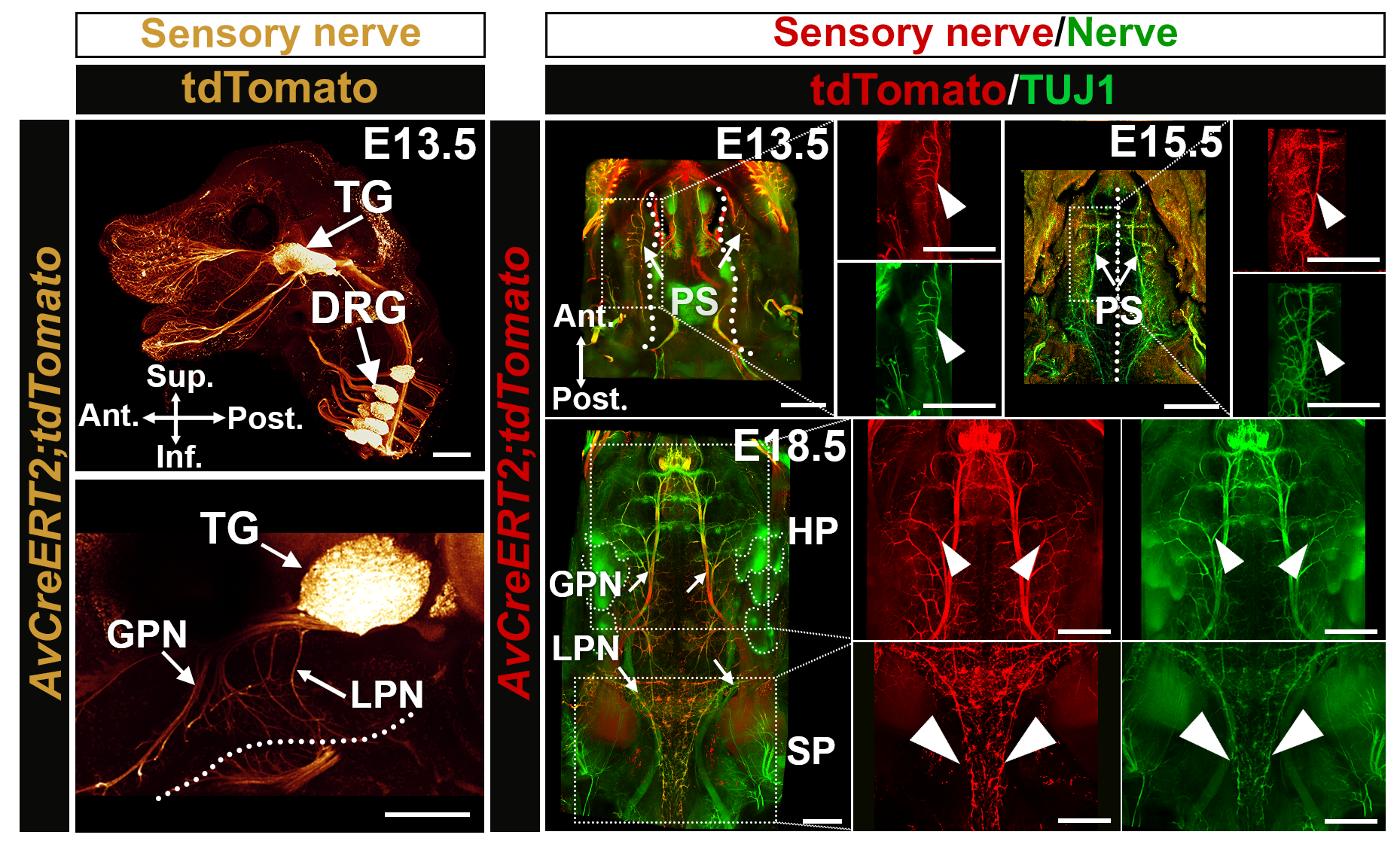
Proper oropharyngeal function is essential for suckling, feeding, and speech, and relies on the coordinated development of the palate, oropharyngeal musculature, and the cranial nerves that control them. Disruption of this integration leads to severe neonatal complications. However, how neuromuscular architecture is developmentally coordinated to support oropharyngeal function remains unclear. Using single-cell and spatial transcriptomics, we identify trigeminal nerve-derived GDF11 as a crucial regulator of soft palatal muscle architecture that acts through cranial neural crest-derived perimysial cells and is mediated by Akt-FoxO1-Thbs3 signaling to establish muscle structural integrity and bilateral continuity. To assess its functional relevance in vivo, we employ a battery of physiological assays to evaluate oropharyngeal function in neonatal mice and find that sensory neuron-specific Gdf11 deletion recapitulates soft palatal deformities and associated oropharyngeal dysfunction observed in individuals carrying GDF11 mutations, including impaired suckling, reduced oropharyngeal motor efficacy, and abnormal vocalizations. Pharmacological activation of AKT partially restores soft palatal muscle organization and ameliorates associated physiological deficits in Gdf11 mutant mice. Collectively, these findings demonstrate that sensory nerve-derived trophic signaling is indispensable for coordinated oropharyngeal morphogenesis and function, and establish a pre-clinical framework for the therapeutic approach targeting neuromuscular integration in congenital oropharyngeal disorders.
What’s in the dataset
The deposited data are embryonic. Samples come from trigeminal ganglion and palatal shelf tissue at E13.5 and E14.5, spanning eight experiments, 19 biosamples, and more than 25 files. Three assay types are represented:
- Single-cell RNA sequencing of dissected tissue
- Bulk RNA sequencing
- SeqFISH spatial transcriptomics, preserving positional information across the palatal shelves
Processing used Cell Ranger 9.0.0 and SGNlite, with sequencing on Illumina NextSeq 500 and NovaSeq platforms.
The data are open access and can be downloaded directly from FaceBase.
This work was supported by NIDCR grants R01 DE012711 and U01 DE028729 to Yang Chai. The U01 is a FaceBase data generation project, making this a case of FaceBase-funded research depositing its underlying data back into the repository.
FaceBase Dataset:
Sa Cha, Jifan Feng, Tingwei Guo, Lin Meng, Peng Chen, Calista Ly, Thach-Vu Ho, Pedro Sanchez, Lauren E. McElvain, Jeffrey D. Moore, Yang Chai. Investigating Oropharyngeal Development in Neonatal Mice Using scRNA sequencing, RNA sequencing, and SeqFISH. FaceBase Consortium https://doi.org/10.25550/8N-FGKC (2026).
Associated Publication:
Cha S, Feng J, Guo T, Meng L, Chen P, Ly C, Ho TV, Sanchez-Lara PA, McElvain LE, Moore JD, Chai Y. Sensory nerve-derived signaling coordinates oropharyngeal structural organization that supports suckling and vocalization in neonatal mice. Nat Commun. 2026 Jul 14. Advance online publication. https://doi.org/10.1038/s41467-026-74959-0