
Published 08 September 2026
FaceBase has released a new dataset from the Chai Lab at USC examining how the tissue surrounding a developing tooth root recruits the sensory nerves that will eventually supply it.
Developing organs do not simply receive innervation; they have to instruct it. Tooth root development is a useful place to watch that happen, because root morphogenesis and sensory innervation begin and progress at the same time in the same tissue. What has been unclear is which signals the surrounding mesenchyme uses to direct incoming axons, and how those signals are controlled.
Contributors: Heliya Ziaei, Mingyi Zhang, Tingwei Guo, Jifan Feng, Lin Meng, Angelita Araujo-Villalba, Junjun Jing, Thach-Vu Ho, Yang Chai (USC)
Description:
Apical molar mesenchyme was collected at postnatal day 3.5 from control (Kdm6bfl/fl), mutant (Osr2-Cre;Kdm6bfl/fl), and rescue (Osr2-Cre;Kdm6bfl/fl;Ezh2fl/+) mice and profiled two ways. Bulk RNA-seq (n=3 biological replicates per genotype, each pooled from four animals) captures the transcriptional consequences of losing Kdm6b in dental mesenchyme. CUT&RUN sequencing for H3K27me3, with matched IgG controls, maps the repressive chromatin marks that mediate them. All libraries were sequenced on an Illumina NovaSeq.
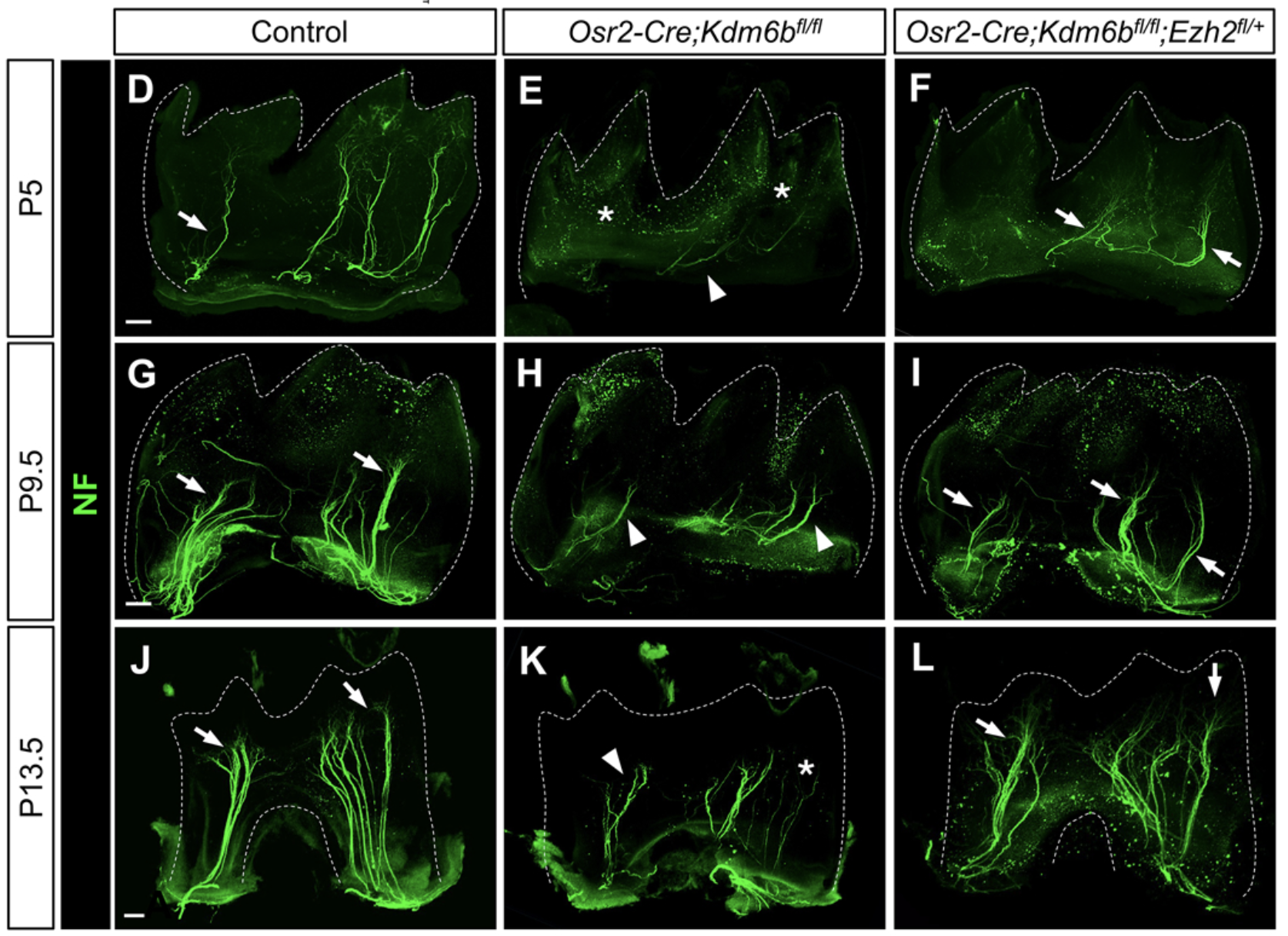
The associated study, published in PNAS in 2026, found that mesenchymal loss of Kdm6b reduces expression of the BMP antagonist Bambi through changes in H3K27me3, which overactivates BMP signaling and in turn suppresses the neurotrophic factor NGF. Without that mesenchymal support, trigeminal axons fail to enter and branch into the dental pulp, and root development is disrupted. Removing one copy of Ezh2, which opposes Kdm6b, partially restores Ngf expression, innervation, and root formation.
Supported by the National Institute of Dental and Craniofacial Research (award R01DE012711).
Accessing the data
This dataset is openly available. Files can be downloaded directly from the dataset record; no application is required.
FaceBase Dataset:
Heliya Ziaei, Mingyi Zhang, Tingwei Guo, Jifan Feng, Lin Meng, Angelita Araujo-Villalba, Junjun Jing, Thach-Vu Ho, Yang Chai. KDM6B Acts via BMP Signaling During Root Morphogenesis. FaceBase Consortium https://doi.org/10.25550/A2-0AAR (2026).
Associated Publication:
Ziaei H, Zhang M, Guo T, Feng J, Meng L, Araujo-Villalba A, Jing J, Ho TV, Chai Y. Epigenetic regulation of mesenchymal BMP signaling directs postnatal organ innervation. Proc Natl Acad Sci U S A. 2026 Jul 7;123(27):e2605881123. doi: 10.1073/pnas.2605881123. Epub 2026 Jun 30. PMID: 42378299; PMCID: PMC13342922.