
New release: Bulk RNA-seq and Cut&Run-seq analysis of control and Gli1CreER;Kdm6bfl/fl adult mouse incisors
July 30th, 2026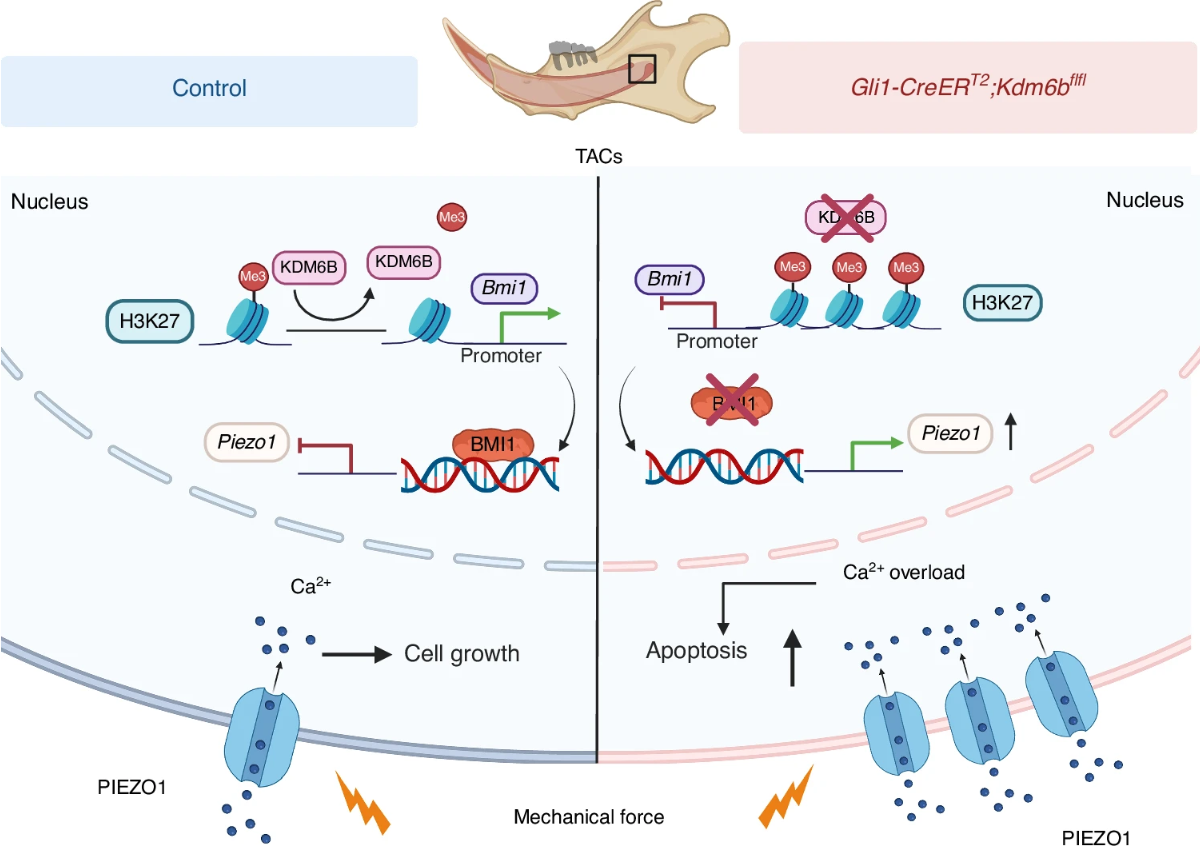
A new bulk RNA-seq and Cut&Run-seq dataset from the University of Southern California is now available in FaceBase!
Contributors: Lin Meng, Mingyi Zhang, Jifan Feng, Tingwei Guo, Hana Hekmat, Heliya Ziaei, Peng Chen, Aaron Harouni, Thach-Vu Ho, Yang Chai (University of Southern California)
Description:
This study examined how mineralized tissues adapt to sustained mechanical stress, using mouse incisor models under varying degrees of loading. The data identify the histone demethylase KDM6B as an epigenetic regulator that preserves tissue homeostasis by protecting progenitor transit-amplifying cells from mechanical stress-induced apoptosis. Loss of Kdm6b increases H3K27me3 at the Bmi1 promoter, silencing Bmi1 and derepressing Piezo1, which drives excessive Ca2+ influx and apoptosis — while Piezo1 haploinsufficiency in Kdm6b-deficient mice rescues both the transit-amplifying cell defects and tissue homeostasis. Together the findings describe a KDM6B–H3K27me3–BMI1–PIEZO1 “mechanostat” that shields dental progenitor cells from mechanical stress. The dataset compares control and Gli1CreER;Kdm6bfl/fl adult mouse incisors by bulk RNA-seq and Cut&Run-seq.
FaceBase Dataset:
Lin Meng, Mingyi Zhang, Jifan Feng, Tingwei Guo, Hana Hekmat, Heliya Ziaei, Peng Chen, Aaron Harouni, Thach-Vu Ho, Yang Chai. Bulk RNA-seq and Cut&Run-seq analysis of control and Gli1CreER;Kdm6bfl/fl adult mouse incisors. FaceBase Consortium https://doi.org/10.25550/88-ZJCW (2026).
Publication:
Meng, L., Zhang, M., Feng, J., Guo, T., Hekmat, H., Ziaei, H., Chen, P., Harouni, A., Ho, T.-V., & Chai, Y. KDM6B safeguards mineralized tissue homeostasis from mechanical stress through epigenetic control of PIEZO1-mediated mechanotransduction in the mouse incisor. Bone Research 14(1), 59. https://doi.org/10.1038/s41413-026-00544-2 (2026).
Image: Schematic representation of KDM6B safeguarding tissue homeostasis to mechanical stress through epigenetic control of PIEZO1- mediated mechanotransduction. Using the mouse incisor as a model of mechanical loading, we reveal that within TACs, Kdm6b demethylates H3K27me3, thereby relieving the repression of the Bmi1 gene. Normal BMI1 inhibits Piezo1 expression. This maintains physiological PIEZO1 levels, ensuring calibrated Ca2+ influx for proliferation and differentiation. In contrast, loss of Kdm6b leads to an accumulation of H3K27me3 at the Bmi1 promoter region, which silences Bmi1 expression and diminishes BMI1 formation. This reduction results in pathologically increased PIEZO1 ion channels in the membrane. The subsequent Ca2+ overload triggers TAC apoptosis while reducing proliferation and differentiation. Ultimately, these molecular events compromise tissue homeostasis. Schematic created with BioRender.com. Ho, T. (2026) https://BioRender.com/8mzv4a3
New release: FGF signalling orchestrates multiple roles during salivary gland branching morphogenesis
May 26th, 2026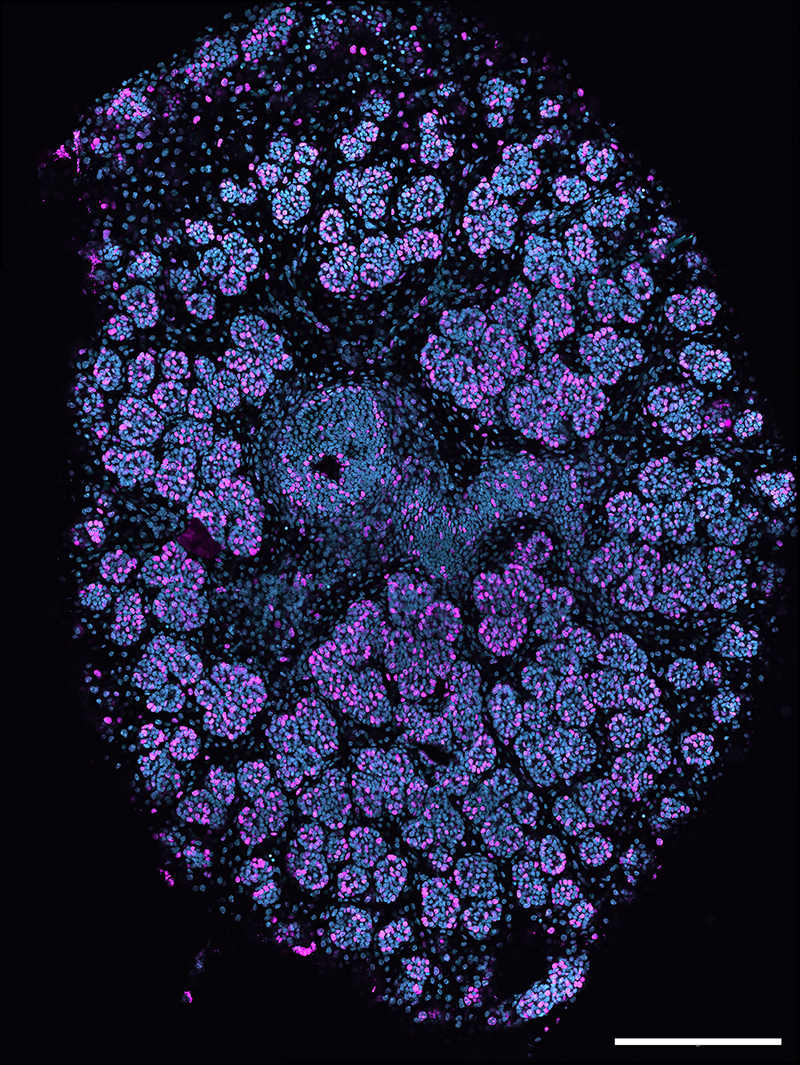
A new bulk RNA-seq dataset from King’s College London is now available in FaceBase!
Contributors: Abigail S. Tucker, Marta Perera, Joshua Brickman (King’s College London)
Description:
This study examined the role of the fibroblast growth factor (FGF) signalling pathway during branching morphogenesis in the murine embryonic submandibular salivary gland. The data compare pharmacological FGFR inhibition with conditional deletion of Fgfr2 (K14Cre;Fgfr2fl) from E13.5 +48 hours, revealing a multitude of roles for FGF signalling — including effects on fate decisions and tissue interactions. The dataset includes bulk RNA-Seq fastq files and the related counts matrix.
FaceBase Dataset:
Joshua Brickman, Abigail S. Tucker, Marta Perera. FGF signalling orchestrates multiple roles during salivary gland branching morphogenesis. FaceBase Consortium https://doi.org/10.25550/AH-J1XR (2026).
Image: Salivary gland stained with BrdU (proliferative cells, magenta) and DAPI (cyan). Image courtesy of Marta Perera.
New release: Amelogenin phosphorylation affects key regulatory genes in the enamel organ
April 30th, 2026A new amelogenin dataset is now available on FaceBase!
Contributors: Elia Beniash, Henry Margolis at the University of Pittsburgh (University of Pittsburgh)
Description:
Amelogenin (AMELX) is the predominant enamel matrix protein and has a single phosphorylation site at Serine 16 (S16), which enhances its ability to stabilize amorphous calcium phosphate in vitro. To investigate the in vivo role of AMELX phosphorylation, a knock-in mouse model (AmelxS16A) was generated in which S16 is substituted with Alanine to prevent phosphorylation. KI enamel is hypoplastic, lacks enamel rods, and features multiple ectopic calcifications; KI ameloblasts also lack Tomes’ processes and show progressive cell pathologies.
To characterize these effects comprehensively, single-cell RNA sequencing was performed on incisal enamel organs from WT and KI mice. 624 genes were differentially expressed across total enamel organ cell populations. Notably, Shh was downregulated 5.1-fold and Wnt5a was upregulated 8.1-fold in KI secretory ameloblasts compared to WT. Ten distinct cell populations were identified, with secretory ameloblasts showing the greatest transcriptomic impact, indicating that AMELX phosphorylation influences not only extracellular enamel matrix processes but also key intracellular pathways governing ameloblast biology.
FaceBase Dataset:
Elia Beniash, Henry Margolis. Amelogenin phosphorylation affects key regulatory genes in the enamel organ. FaceBase Consortium https://doi.org/10.25550/AF-V3VC (2026).
New release: Mandible vs tongue involvement in cleft palate in mouse models
April 22nd, 2026A new dataset is now available on FaceBase from Goodwin, Green, and colleagues at the University of Pittsburgh. Their study examines the respective contributions of mandibular hypoplasia and tongue malposition to cleft palate in Pierre Robin sequence (PRS), using two complementary mouse models. A related manuscript has been accepted for publication in the Journal of Dental Research.
 Comparison of palate outcomes in the Sox9fl/fl;mtHand2Cre Pierre Robin sequence model (left) and the DTA/+;mtHand2Cre micrognathia/microglossia model (right). Image courtesy of Alice Fitzgerald Goodwin.
Contributors: Alice Fitzgerald Goodwin, Jeremy Green (University of Pittsburgh)
Description:
To investigate cleft palate in Pierre Robin sequence (PRS), we generated a mouse model with Sox9 deleted specifically in the mandibular mesenchyme (Sox9fl/fl;mtHand2Cre), which resulted in mandibular hypoplasia and retrognathia, palatal shelf elevation delay, and fully penetrant cleft of the secondary palate. To determine the relative contributions of mandible vs tongue malposition to cleft palate in PRS, we generated a micrognathia and microglossia model (DTA/+;mtHand2Cre). The majority of these animals had a normally formed palate, suggesting that tongue obstruction of palatal shelf elevation is the primary contributor to cleft palate in PRS.
Data deposited on FaceBase include microCT scans of Sox9fl/fl;mtHand2Cre and control embryos at E18.5; H&E-stained coronal sections at E12.5, E13.5, E14.5, and E16.5; proliferation and apoptosis assays at E12.5 and E14.5 in the Meckel’s cartilage; immunofluorescence with antibodies against Pax7 and MHC at E14.5; RNAscope with probes against osteogenic markers at E14.5; palatal shelf explant studies at E13.5; and H&E staining and TUNEL apoptosis staining of DTA/+;mtHand2Cre and control embryos.
FaceBase Dataset:
Alice Fitzgerald Goodwin, Jeremy Green. Mandible vs tongue involvement in cleft palate in mouse models. FaceBase Consortium https://doi.org/10.25550/AB-SJQA (2026).
Publication:
Alice Fitzgerald Goodwin, Jeremy Green; Intrinsic tension drives palatal shelf reorientation post tongue retraction. Journal of Dental Research 2026. (accepted April 21, 2026 — DOI to be added upon publication)
New release: Six2 and CTCF ChIP-seq datasets of wildtype mouse embryonic facial tissues (E10.5 - E13.5)
April 16th, 2026New ChIP-seq datasets are now available in FaceBase, profiling Six2 transcription factor binding and CTCF-defined topologically associating domains in wildtype mouse embryonic facial tissues at stages E10.5 through E13.5. Input libraries are included as controls. Together these data support investigation of gene regulatory networks and chromatin architecture during craniofacial morphogenesis.
Contributors: Jingyue Xu, Han Liu and Rulang Jiang (Cincinnati Children’s Hospital, Medical Center)
Description:
We performed a ChIP-seq assay using a Six2 antibody to identify endogenous Six2-binding genomic loci in mouse embryonic facial tissues. We performed a ChIPseq assay using the CTCF antibody to identify topologically associating domains and boundaries. We generated ChIP libraries and sent them for next-generation sequencing. We also generated input libraries as control samples.
FaceBase Dataset:
Jingyue Xu, Han Liu, Rulang Jiang. Six2 and CTCF ChIP-seq datasets of wildtype mouse embryonic facial tissues (E10.5 - E13.5). FaceBase Consortium https://doi.org/10.25550/7Z-41CW (2026).