
EarBase
Who We Are
The NIDCD Temporal Bone Initiative
The NIDCD Temporal Bone Initiative is a non-profit project sponsored by the National Institute for Deafness and Other Communication Disorders (NIDCD), which is a branch of the National Institutes of Health. NIDCD’s mission is to advance the science of communication to improve lives through training and research in hearing, balance, taste, smell, voice, speech, and language. These efforts are conducted by teams of dedicated clinicians and scientists at universities and hospitals throughout the U.S., including our headquarters in Bethesda, MD.
Background and history
The human temporal bones contain the organs of hearing and balance, as well as nerves important for taste and the control of muscles in your face for facial expressions. Historically, the collection of temporal bones for research dates to early reports from the 1700s, and their importance has steadily increased over the decades. Responding to the need for better treatments for disorders of hearing and balance, research over the decades has benefitted from donated temporal bones to support breakthroughs such as the cochlear implant and gene therapy.
To meet the growing need for tissue donations and promote research, the National Temporal Bone Banks Program was founded in 1960 at the Massachusetts Eye and Ear Infirmary, with support from NIH (NIDCD) and the Deafness Research Foundation (now Hearing Health Foundation). This program coordinated the efforts of 28 laboratories and clinics across the country to encourage tissue donations for research and clinical training. Continued support of that program was added in 1992 with the founding of the NIDCD National Temporal Bone Registry. In 2022, the NIDCD renewed its support for these programs by establishing the Temporal Bone Initiative, in an effort to modernize and expand resources for this rapidly evolving field.
An integrated resource for clinicians and researchers
The NIDCD Temporal Bone Initiative combines three integrated resources to support the work of clinicians and researchers and advance our mission.
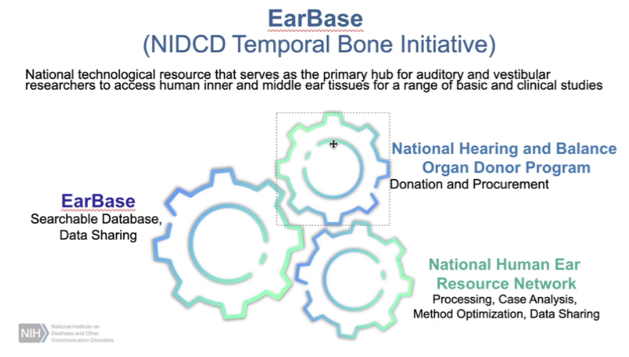
- National Hearing and Balance Organ Donor Program (NHBODP): Our nationwide tissue donation program recruits donors willing to support our research with an anatomical gift. The program is administered by the National Disease Research Interchange (NDRI) through its Human Tissues and Organs for Research Resource (HTORR) Program.
Learn more > - National Human Ear Resource Network: The National Human Ear Resource Network is a collaborative of five Human Temporal Bone Laboratories dedicated to advancing auditory and vestibular research by conducting studies, sharing knowledge and resources, and making tissue samples available to a wider community of researchers, scientists, and clinicians.
Learn more > - EarBase: EarBase is a database and repository containing clinical data and high-resolution images of the human temporal bone suitable for research and analysis. Its purpose is to facilitate data access, sharing, collaboration and foster new discoveries by offering an environment where data can be archived, reviewed and analyzed. EarBase is fully integrated with the FaceBase platform, where the data provided by craniofacial and temporal bone researchers are made available to the research community.
Browse data >